

Can You See the Difference?
These photos are a perfect example of how subtle the difference really is. And the bright color of these highlights is the perfect way to give you a clear picture of just how they differ.
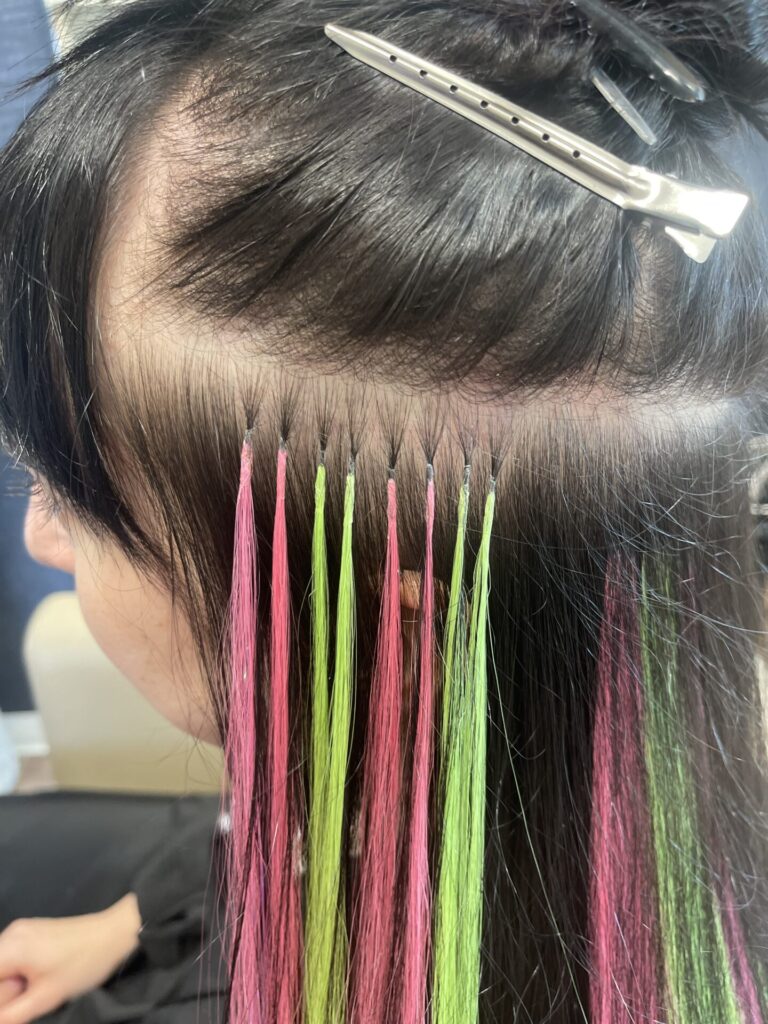
 In the first photo, I'm installing bright pink and lime green K-tips on the side of her head using traditional thermal fusion, creating small, rounded attachments.
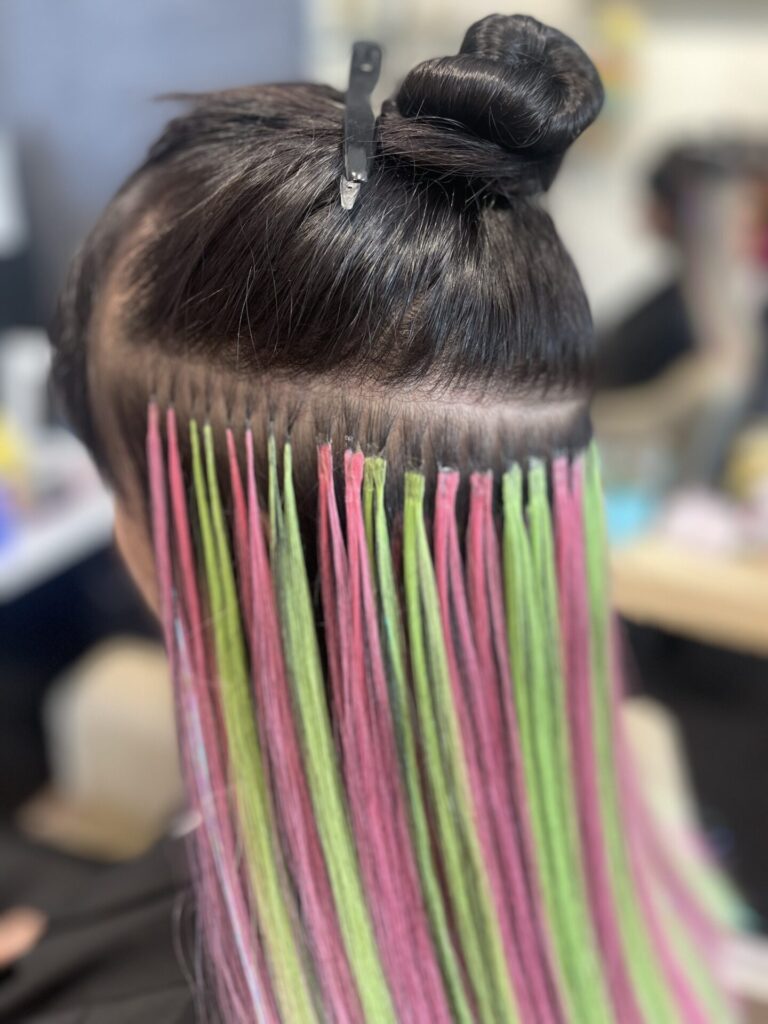
In the second photo, as I move towards the back of the head, I've switched to flat attachments.
Look closely at the attachment points. Even with these bright fashion colors, the difference between the round and flat bonds is barely noticeable.
Imagine how discreet they'd be with extensions that match your natural hair color!
You can also see that the flat attachments allow me to work with slightly more hair in each piece. That's particularly helpful when I want to distribute colorful accents or highlights in a very specific way.
 All
 Google
 Website

This woman is amazing. I flew in from Wisconsin. I was growing out my grey and didn’t want to lose my length. She met with me online prior to our appt. Picked appropriate shades and was ready for my arrival. We spent the entire day together. Overall adding 480 sections of hair. The results were asto... read more

Heather is incredible ! She truly is a hair extension artist. I'm almost a year into growing out my silver/natural hair and was in not a good place with my grow out process, so far. I have fair skin, light eyes and had dyed my hair for over 30 years, dark chocolate brown. I've shared my inspiration... read more

I am so happy I found Heather to help with my transition to gray hair. The extensions helped boost my self confidence along with the acceptance of my graying hair. It was the right choice for me to not keep coloring my roots every 2 weeks and also not feel frumpy with the skunk hair stripe. I now lo... read more

Heather is amazing!! She is very thorough with her consultation and her highlights are my favorite! Blonding services can be hard to find, and she is a real pro! I love the way she styled and did my hair!

Heather is amazing! She is very talented easy to talk to and very sweet. Her room was beautiful. She matched my extension color seamlessly. She is so talented. If you’re looking for an extension specialist she’s your girl!

Heather is amazing!! I travel in from out-of-state every few months to have her color my hair and to add extensions because there is no one greater than she is at it. I've been coming to her for years and always get compliments. I have very thin hair and she is a magician. If you want true quality,... read more

Heather is AMAZING! I moved to Denver from Houston a few months ago, was looking for a new hairstylist, and found Glo Extensions after some extensive research. I’ve been dying my hair blonde for over 10 years and the only experience I had with extensions were sewn in wefts. During my consultation, I... read more

Heather did such an amazing job! I have fine thin hair and wanted to add some volume and a bit of length so we opted for ktip extensions. She color matched me PERFECTLY and my extensions look amazing! I left today feeling so confident

Heather is the best! My K-tip extensions and color look stunning. I’m obsessed. Thank you, thank you, thank you! I love my hair! I’m a client for life!

Heather has been doing my hair for years. I can honestly say her skill with color and hair extensions is unmatched. She is able to blend my color and cut flawlessly and I get so many compliments on my hair. Red is not an easy color to maintain but I swear the red she creates lasts and my extensions... read more

Heather is truly the best of the best at what she does. I have been to several salons for extensions, and no one compares to her. Her knowledge and expertise have kept my hair healthy and growing so much that I don’t even need extensions anymore. That alone says everything. She is also the only styl... read more

BEST HAIR EXTENSIONS EVER. I love everyone who works here, they are so sweet, fun, and extremely good at what they do. I’ve been coming for about 3 years. I took out my extensions in August but I couldn’t stand not having them in so I got them back in during December. You do not even need to get ext... read more

