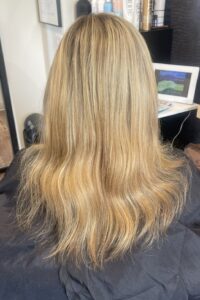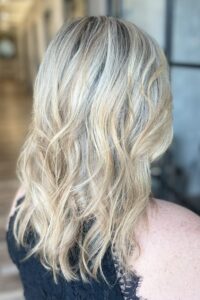
transition from wefts to ktips

Is It Time to Switch From Wefts to K-Tip Hair Extensions?

If you got weft extensions in the last couple of years because everyone seemed to be wearing them, you weren't alone.

Hand-tied wefts, Genius Wefts, Envy Wefts and other variations of beaded row extensions had a huge surge in popularity in 2024 and 2025. Wefts weren't new, but they became trendy. Clients were asking for them, salons were promoting them, and stylists were taking classes specifically to learn how to install them.

Now I'm seeing the other side of that trend.

Why Women Are Replacing Their Wefts

I'm getting more women coming to Glo because they aren't happy with their weft extensions. Their scalp feels tender. Their extensions feel heavy. They don't like how restricted they are when styling their hair. Some have visible areas of thinning or tension around the attachment points.

And quite a few tell me the same thing after I remove their wefts and replace them with K-tip extensions:

"I wish I had done this sooner."

The problem isn't necessarily the quality of the extension hair. Wefts can be beautiful on the right client. The bigger issue is whether the attachment method is appropriate for your natural hair and whether the person installing it has the experience to recognize when it isn't.

Weft Extensions Aren't Right for Everyone

A weft is essentially a curtain or row of extension hair that is attached across sections of your natural hair.

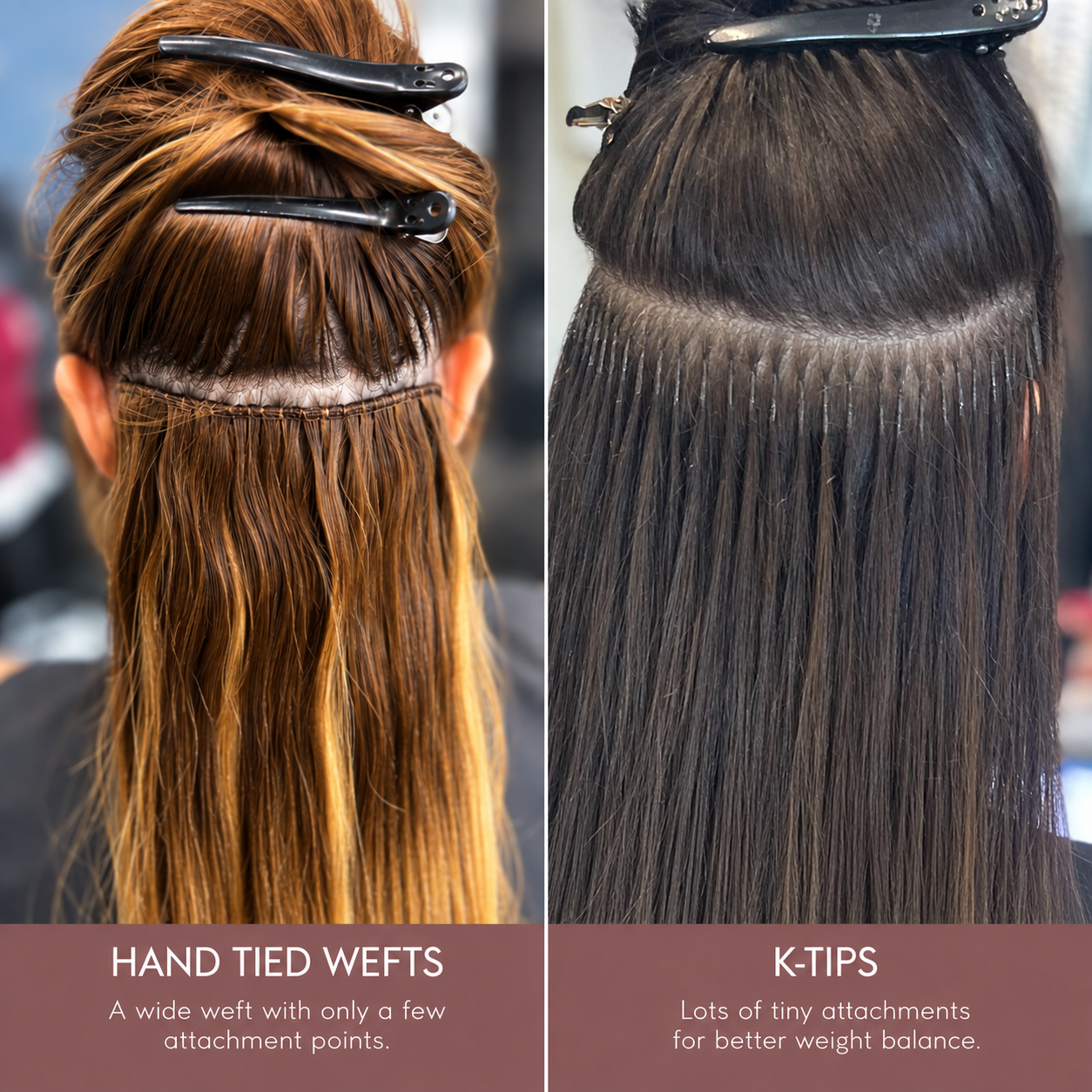
You'll hear different names for wefts, including hand-tied wefts, Genius Wefts, Envy Wefts and other branded systems. There are differences between products and installation techniques, but they have one important thing in common: a larger amount of extension hair is supported along a limited number of attachment areas.

For someone with the right density, strength and styling habits, that can work very well.

But not everyone has the hair to support it comfortably.

I am especially cautious about wefts on women with fine hair, lower density or limited coverage around the crown and sides.

Even though a weft may have fewer individual attachment points than K-tips, you're still asking those attachment areas to support the weight of an entire row of extension hair. On the wrong head of hair, that can feel heavy or uncomfortable and may put too much tension on the natural hair supporting the weft.

Why Do My Weft Extensions Feel Heavy or Hurt?

Your extensions shouldn't leave you constantly aware that you're wearing extensions.

Some tenderness immediately after an installation can happen, but ongoing pulling, discomfort or a heavy sensation deserves attention.

Sometimes the issue is the installation itself. Sometimes there is simply too much extension hair for the client's natural hair to comfortably support. And sometimes the client wasn't an ideal candidate for a weft in the first place.

The placement of a weft also concentrates the attachment along rows. If excessive tension is repeatedly placed on the same areas of natural hair, breakage or thinning can occur.

That is one of the reasons I don't choose an extension method based on what happens to be popular.

I choose it based on the hair in front of me.

Hair Extension compare wefts vs ktips

Why Were So Many Women Put in Wefts?

During the height of the weft trend, a lot of stylists trained specifically in weft installation.

That's not necessarily a problem. There are talented extension specialists who do beautiful weft work.

The limitation comes when a stylist knows one extension method and tries to make that method work for almost every client.

Hair extensions aren't one-size-fits-all.

Your natural density, strand strength, haircut, lifestyle, styling preferences, desired length and the areas where you actually need additional hair should all influence the attachment method.

That's also why experience with multiple extension methods matters. When your stylist has more than one tool available, the consultation becomes:

"Which extension method is best for your hair?"

Instead of:

"How can I put the extension method I offer into your hair?"

Why I Prefer K-Tip Extensions for Many of My Clients

At Glo, my specialty is individual keratin bond extensions, often called K-tips or fusions. I primarily work with Great Lengths keratin bonds because they give me an enormous amount of control over the finished result.

Rather than installing a row or curtain of hair, K-tips are installed as individual bonds.

That changes what I can do with them.

I can customize where the additional hair goes, how much is added to a particular area and how the extensions move with your natural hair.

For many clients, the result simply feels more like their own hair.

K-Tips Give Hair More Natural Movement

Because K-tips aren't connected together in a row, the individual extensions can move independently.

That creates the soft, flowing movement most women are actually trying to achieve when they invest in extensions.

The extensions don't have to look like "extension hair." They become part of the haircut.

K-Tips Give Me More Control Over Placement

You may not need the same amount of additional hair everywhere.

Maybe your ends are thin and need filling in. Maybe you need more density through the sides. Maybe one area has less natural hair than another.

Individual bonds allow me to customize the application instead of placing a full row across the head simply because that's where a weft needs to go.

That flexibility is also why I use Great Lengths K-tips for some of my more specialized work, including filling in thin or straggly ends and extension-based salt-and-pepper hair transitions.

K-Tips Are Easier to Hide in More Hairstyles

If you love wearing your hair up, in a ponytail or half-up, attachment placement matters.

A weft creates a horizontal attachment that you need enough natural hair to conceal.

K-tips are individual attachments, which gives me much more flexibility in placement and gives you more freedom when styling your hair.

For the right client and the right installation, you can pull your hair up and still have an incredibly natural result.

K-Tips Can Be a Better Option for Fine Hair

Fine hair doesn't automatically mean you can wear K-tips, either. Your natural hair still has to be healthy enough to support extensions, and that's something I evaluate during your consultation.

But individual bonds give me much more ability to customize the amount and placement of extension hair based on what your natural hair can safely support.

You don't necessarily need a massive amount of hair to make a significant difference.

Sometimes strategically placed extensions are exactly what is needed.

Learn more about our Great Lengths K-Tip Service

Does That Mean Weft Extensions Are Bad?

No.

I don't believe there is one "best" hair extension method for every person.

Wefts can be a good option for clients with enough natural density and strength to support them, particularly clients who primarily wear their hair down and want to add significant volume.

I will still install wefts for select clients when I believe they are a good fit.

But they aren't the method I specialize in or recommend most often. I prefer the movement, customization and natural appearance I can achieve with individual K-tip extensions.

And I won't recommend a weft simply because it's the extension method someone walks in asking for.

A Real Client Who Switched From Wefts to K-Tips

One of my clients originally came to Glo because she wasn't happy with extensions installed at another salon.
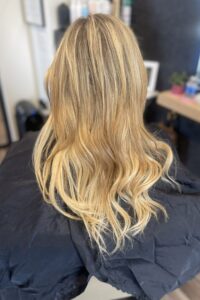
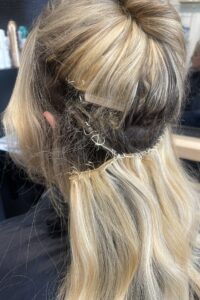
She was wearing a combination of tapes and wefts. They felt bulky in her fine hair, and when she wore her hair up, the extensions were too obvious.

When I inspected the installation, there were additional problems. The extension color wasn't properly matched to her natural hair, the wefts had been folded rather than appropriately sized, and there was excessive thread that contrasted with her rooted hair color.

At that point, the best decision wasn't to try to disguise a bad installation.

We removed all the extensions.

We gave her natural hair a break, refreshed her cut and color, and developed a plan for the next visit, based on her actual hair rather than simply repeating the method she had before.

This is something I'm doing more and more for women who come to me unhappy with their wefts.

Wefts vs. K-Tips: What's the Difference?

When I'm deciding which extension method makes sense, I look at much more than how long you want your hair.

Wefts may be appropriate when:

  • You have sufficient natural density and strength to comfortably support the rows.
  • You have good coverage around the crown to conceal the attachments.
  • You primarily wear your hair down.
  • You want substantial volume and your natural hair can support it.
  • Your hair and lifestyle are genuinely well suited to a weft installation.

I tend to prefer K-tips when:

  • You want extensions that flow better with your natural hair.
  • You frequently wear your hair up or half-up.
  • You have finer hair or less coverage in certain areas.
  • You want the finished result to look and behave as much like your own hair as possible.

The important distinction isn't which method is trending.

It's which method is appropriate for your hair.

Already Wearing Wefts and Not Happy With Them?

If your wefts feel heavy, your scalp is constantly tender, you're struggling to hide the attachments or you simply don't like how your extensions move and style, you don't necessarily have to give up hair extensions.

You may just be wearing the wrong type.

I've worked with virtually every major attachment method and have personally worn many of them myself. That experience allows me to look at what you're currently wearing, assess your natural hair after removal and determine whether Great Lengths K-tips or another extension option would be a better fit.

Sometimes the biggest difference isn't changing the hair.

It's changing how the hair is attached.

Book a FREE Hair Extensions Consultation at Glo

If you're thinking about switching from wefts to K-tips, start with a consultation.

Bring me the hair you have now, even if you hate it. I want to see how it was installed, how your natural hair is responding and what isn't working for you.

We'll talk about how you actually wear your hair, where you want more length or fullness, and what your natural hair can comfortably support.

Then we'll build your next set of extensions around your hair, not around an extension trend.

Book your consultation appointment by using the online form or calling the salon.

303-968-4222

Check all that apply. Consultations are free of charge.
You can opt-out using the unsubscribe link contained in every email.

5 stars png transparent 300x200 1Hair Extensions Reviews for Glo Salon in Denver

1 Rate Your Visit

1 2 3 4 5

2 Your Review

All
Google
Website
Overall Reviews
Rated 4.8 out of 5 ★★★★★ (336)